And just like that it is bonus Saturday morning…
I love three day weekends and getting a Saturday do-over.
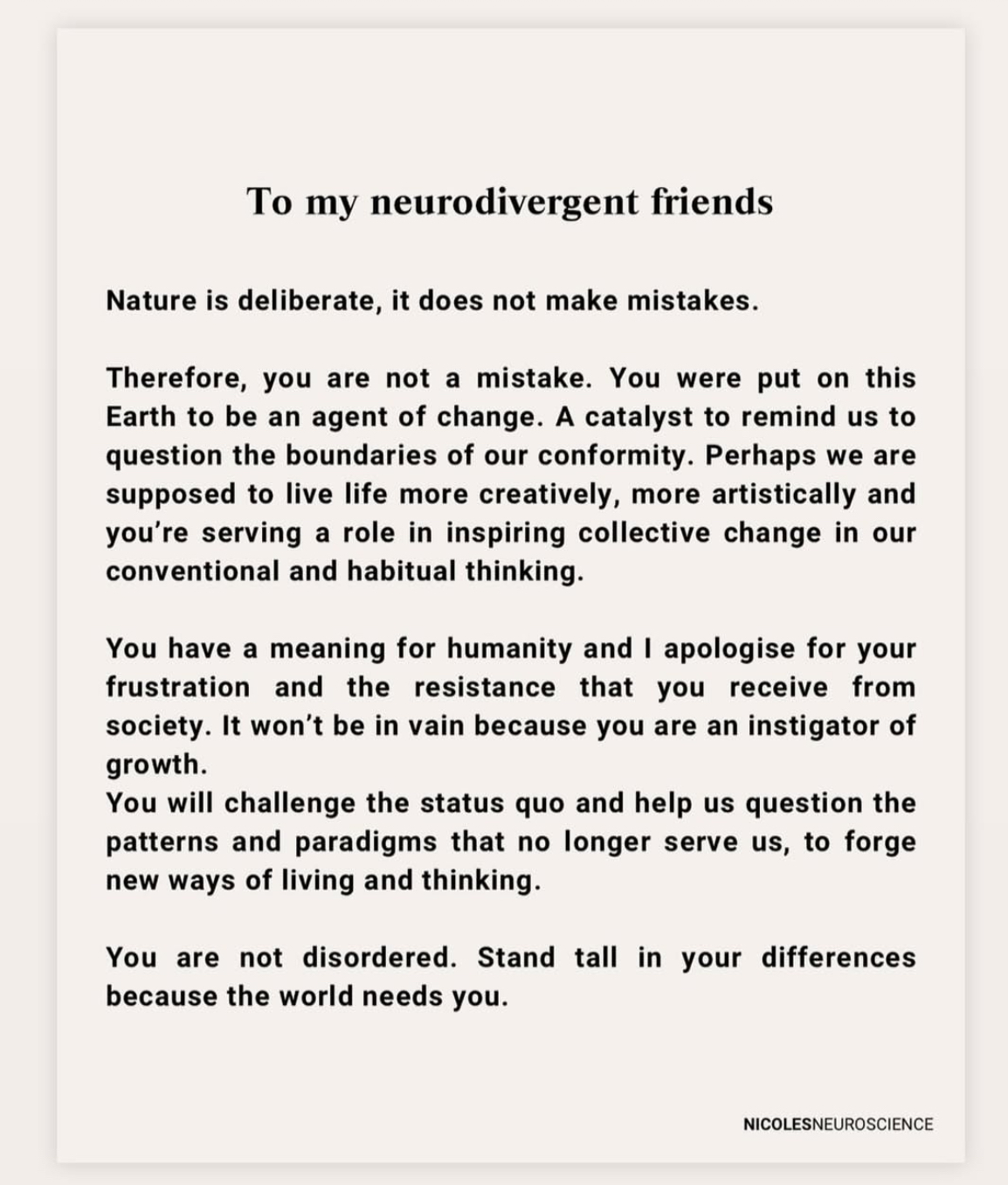
In the school world, working with students over the years whom are considered to have social, academic, and/or emotional differences (see image below that includes the perfect language to describe my wholehearted belief), ‘transition’ is a word often used. A ‘transition’ can be somewhat interchanged with the verb ‘to shift’. Humans can access their higher order thinking (executive function skillsets) to manage transitions in day-to-day living. Shifts can occur in thinking, feeling, behavior, and outcomes. It’s not ‘if’ shifts happen, it’s ‘when’. (I would link my dad as a reference for that general piece of wisdom – at the time, it had to do with saving money for things like new tires…).
The reason I am opening this post with ‘transition’ is because I am feeling much gratitude this morning for the extra day to put the finishing touches on my most recent transition back into the day to day experience of life after a long winter holiday. This includes a global transition into a new calendar year, or 365 day cycle. For some, cycles are felt rather than explained – this includes days, weeks, months, and years.
For me, the transition focus is lifestyle habits such as sleep, nutrition, and hydration. Fundamental to healthy outcomes is my living environment set up to support the habits that allow the best version of me to do ‘day’. This includes exciting things like getting rid of what I don’t need, cleaning, and organizing all the ‘areas’ (or ‘zones’ as is taught by Sarah Ward, executive function expert). Next on the list is getting out ahead of planning. Yes, this can include doing ‘work’ during my free time, but it is important to care for Future Sally (another executive function tip to master procrastination as learned from GoZen! course on EF …based on the research of Psychologist and world-renowned procrastination expert, Dr. Tim Pychyl).
It seems having a general understanding of transitions and shifts can broaden one’s capacity of understanding self and others. This awareness grows Shared Humanity and the human collective. It can improve relationships as we get curious as to how we are showing up and expressing ourselves in day. Being curious about transitions and shifts is not to enable or make excuses for unhelpful behavior, it’s an understanding. Managing transitions is a skillset that can grow with practice that begins with awareness (or to identify what’s happening – ie lagging results or outcomes).
The podcast share for this week is Trevor and Christiana having a conversation with Simon Sinek on What now?.
First off, Christiana absolutely CRUSHES it as an authentic human having an authentic conversation. I do not have good conversational skills, nor do I have confidence in conversation. Therefore, when I listen to podcast interviews, one of the things I love/admire is the hosts ability to ask questions and interact with the guests. I consider this a talent. Some hosts talk too much and the show feels as if it is about them – which could be why people listen to the show in the first place (ie they love the host or hosts). I suppose this is true for me when it comes to Trevor Noah. I love Trevor Noah. If one has listened to (I say ‘listened to’ because he narrates his book on Audible and it is….brilliant), Born a Crime by Trevor Noah, I assume that one will have a broader understanding and interest in Trevor as a human.
One topic the three discuss is workplace gossip, or just gossip in general. In my workplace, we were just discussing this topic on Friday during our Dare to Lead time. (side note – it seems Simon Sinek, Brene Brown, and Adam Grant are all popular ‘organizational psychologists’ – google search tells me Simon Sinek is an Ethnographer, and I know Brene’s academic background is Social Work but she works with organizations – click on the links to their websites if you are curious to have more context).
For me, gossip is something that I (and others) feel energetically. It’s not so much an ethical or moral consideration, it’s the spreading of energy that is often opinion and can change quickly – yet the false information is already spreading once the truth or new perspective shows up…and the truth may not be as interesting. Just like is said in the interview, false information contributes to the split we are experiencing – collectively we are not in congruence. When we speak one way, and feel another, we contribute to a split energy. Individually, if one silently commits to being in congruence (thoughts, feeling, behavior, desired outcomes – aligned or congruent with one’s values) when information is shared, this effort can contribute to one’s environment and experience of day.
I’ll let you come up with your own conclusions should you listen to the podcast.
I’m going to close with another connection to the past week in my world. I have mentioned my recent Yoga Teacher Training with Jordan Smiley of Courageous Space in Denver.
I have the opportunity to facilitate yoga to 10th grade students this semester. It’s once a week for nine weeks. Each week I am introducing a Yama/Niyama, ethical guidelines, taken from Patanjali’s Yoga Sutra. Jordan teaches the history of yoga and the difference between the cultural appreciation of yoga and its lineage of teachers, as opposed to the cultural appropriation of yoga and its lineage of teachers.
The first yama is Ahimsa, or non-harm. The second is Satya, or truthfulness.
Now consider gossip.
I’ll allow you to ‘fill in the blanks’.
“Yoga is not a belief system or a religion, but an approach to life,” (as found in my notes from Jordan’s teacher training).
 sally's blog.
Leave a comment