This past week I have been mentally prepping to facilitate my content for the fourth time, or better said: I have a fourth opportunity to facilitate my content to students who are about to graduate, or complete the requirements to receive a high school diploma.
I suppose it’s relevant to storyitell if I make a comparison to a roadtrip. As it relates to the content ‘course’, I am still in the beginning of the trip, stopping the fourth time to fill up the tank. As my dad would say, ‘I’m gaining on it.’
I have learned a lot over the past three opportunities, and my biggest curiosity continues to be how to authentically engage students. I enjoy experiential activities. In this evening class, we have (almost) all just completed a ‘day’. Most, if not all, the students have worked a job prior to coming to school between 1:30 and 3pm. I have worked a full day prior to showing up for the 4:20 start time. Experiential activities are not often well received by tired individuals, or well facilitated.
I requested the opportunity to facilitate my content because I want to learn how to share it, in a way that feels authentic, relevant, and engaging. The school is where I initially created the content, in the class by the same title when it began over a decade ago.
Some gains I have made that I am taking into the new semester, include:
- Activate prior knowledge.
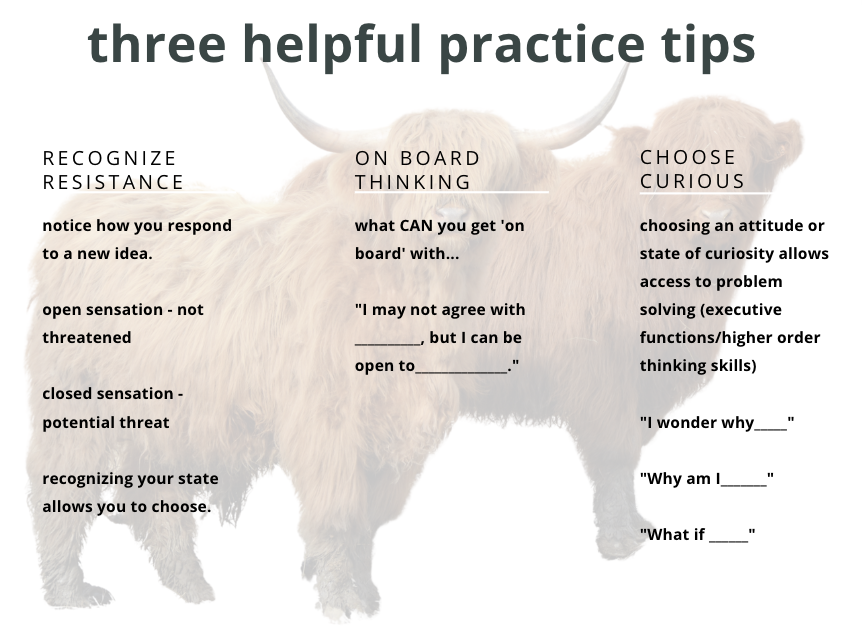
This is most likely the most basic consideration for those who ‘teach’. I suppose I address it in part III of storyitell in the section titled tips. As a facilitator, on board thinking would be a mindset for me to cultivate: how do I connect to the audience and create a win-win energy?
- Go slow to go fast.
When I am receiving pay for my ability to do a job, I feel as if I am required to be the one delivering information or skills. This involves action. With that mindset, if I spend 15-20 minutes facilitating a conversation with a group, to my mind I am not ‘giving’ the information, or ‘teaching the skills’ that lead to better outcomes. What I learned last semester, is the one thing that connected me in a meaningful way to the students was a ‘back and forth’ type journal. The students were asked to share a connection, comment, and question based on the content I shared. It was this dialogue that grew in its authenticity over the course of the semester that allowed me to connect in a more authentic and meaningful way with the students, and humanize us both to one another.
The question I have for myself as a result of the journal, is how to fast track connection and bring it into the time we share ‘in person’.
- Use relevant resources.
This is another false belief I have that builds on my previously stated mindset: I feel as if I am being paid to deliver my content in person, not spend the time sharing another person’s content (YouTube or podcast excerpts specifically).
With that said, my podcast share for this post is one that I find meaningful as it relates to my content. I have attempted to integrate it in two of the three prior semesters.
On 1-27-22, Krista Tippet (host of onbeing podcast, and author of this 1-25-25 post titled: The News That Is ‘Breaking’ Is Never Seeing Things Whole), reaired her interview with Thich Nhat Hanh from 9-25-2003 as a remembrance following his death at age 95.
Krista begins the share by stating that although the interview was done in 2003 with relevance at the time to the War on Terror, in 2022 she says: it’s astonishing to re-experience the deep, enduring relevance of this monk’s teachings for our world now.
Here is a section of the 2003 interview I am most curious about:
Tippett:
I look at the violence that marked the world in the period when you were a young monk — there was the Cold War; there was a certain kind of violence and hostility. A lot of that has changed, has gone away, a lot of the terrible threats and the sources of the worst fighting. And now in its place we have new kinds of wars and new kinds of enemies. I’d be really interested in, as you look at this period of your lifetime, is there any qualitative difference between the violence that we have now and the violence that we had then? Is there anything like progress happening, or is it the same pattern that repeats itself?
Thich Nhat Hanh:
Yeah, you are right. It’s the same pattern that repeats itself.
Tippett:
And does that make you despair?
Thich Nhat Hanh:
No, because I notice there are people who are capable of understanding, that we have enough enlightenment, and if only they come together and offer their light and show us the way, there is a chance for transformation and healing.
Tippett:
It seems like we live in an age of collective violence, collective terror, and collective acts of retribution. How do you see the effect of this work that you do?
Thich Nhat Hanh:
Well, peace always begins with yourself as an individual, and as an individual, you may help building a community of peace. That’s what we try to do. And when your community of a few hundred people knows the practice of peace and brotherhood, and then you can become the refuge for many others who come to you and profit from the practice of peace and brotherhood. And then they will join you, and the community gets larger and larger all the time, and the practice of peace and brotherhood will be offered to many other people. That is what is going on.
This lends itself beautifully to a present day podcast listen with Trevor and Christiana interviewing Robert (‘Bob’) Putnam on a 1-23-25 episode of What Now?
This listen references the title of my post, are you lonely?
The interview includes a discussion of the ‘collective we‘ and Christiana challenges the discourse by asking for clarity as to who is the we. Once this is teased out, the question becomes: ‘how does this we contribute to a successful goverment?’ Other topics include: how to integrate tech AND in person connection, the difference between bonding and bridging social capital in a modern diverse society, how public high school was started in 1910 in small towns and went viral as the biggest social reform effort, looking at a class lens as opposed to a racial lens, and three to do’s to build social capital (go young, go local, go morality).
“KT: Is there anything like progress happening, or is it the same pattern that repeats itself? TNH: Yeah, you are right. It’s the same pattern that repeats itself.“
…we can disrupt patterns that don’t contribute to helpful outcomes for the living collective (including plants, animals, nature, etc. ) — yes?
…and we can begin with our own self? — yes.
 sally's blog.
Leave a comment